Pages

Tuesday, July 29, 2008

Study Shows High Omega-3 Levels in Japanese Diet Cuts Heart Disease Rates


Japan's Heart-Healthy Diet: Fish Is Key.
It might be called the Japanese paradox.
Men in Japan have similar lifetime cholesterol, blood pressure, and type 2 diabetes rates as men in the U.S., and they are far more likely to smoke.

So why is it that the rate of heart disease among men living in Japan is less than half that of men living in the U.S. and that Japanese men tend to have less artherosclerosis -- the artery-clogging plaque that leads to heart attacks and strokes?
A new study suggests that the answer may be found in the sea.
High Omega-3 Levels
Because they ate more fish, men living in Japan who participated in the study had twice the levels of omega-3 fatty acids in their blood as white men and Japanese men living in the U.S. They also had less severe degrees of atherosclerosis.

The finding lends support to the hypothesis that omega-3, which is found primarily in fatty fish like tuna, mackerel, and salmon, protects against plaque buildup in the arteries.

Sources of omega-3 fatty acids are fish oils, which contain docosahexaenoic acid (DHA) and eicosapentaenoic acid (EPA), and plant sources. Alpha-linolenic acid (ALA), which is converted into omega-3 fatty acids in the body, is a plant-source omega-3 fatty acid.

Studies have generally used fish oils. While plant sources with ALA may have the same benefits, less is known about them.

"The extremely high intake of fish in Japan may explain the much lower rate of atherosclerosis and subsequent coronary heart disease," researcher Akira Sekikawa, MD, PhD, tells WebMD. "This study does not prove that omega-3 is protecting these men, but we showed that artery thickness decreased as omega-3 levels went up."

The Japanese diet has become increasingly westernized since the end of World War II, but fish consumption in Japan is still among the highest in the world.

People in Japan eat an average of 3 ounces of fish every day, while the average American finds it difficult to manage the two servings of fish a week recommended for heart health by the American Heart Association, omega-3 researcher William Harris, PhD, tells WebMD.

He adds that the average omega-3 intake in Japan of 1 gram a day is about eight times higher than the amount the typical American gets.

"We are not a nation that loves fish, and that isn't likely to change," he says. "But it is increasingly clear that we need to get more omega-3 into our diets."

Fish oil supplements are one way of doing this. Studies in individuals with heart disease have shown a benefit of supplemental omega-3 fatty acids. Based on these studies, the American Heart Association recommends that people with heart disease take 1 gram of EPA plus DHA daily
High Omega-3 Levels continued...
Other good sources of omega-3 include foods such as flaxseed and canola oils, soybean, tofu, and walnuts. Omega-3 fatty acids are often sold as capsules but can upset the stomach and should be taken with food.

Harris is working to develop a soybean-based omega-3-enriched oil through a grant from the company Monsanto.
He believes that many of the foods we eat will soon be fortified with omega-3 in the same way that they are now fortified with folic acid and other vitamins.

"Either we get people in the U.S. to start liking oily fish, which probably isn't going to happen, or we find another way of getting it into our food," he says.

Fish Eaters Had Less Plaque
The study by Sekikawa and colleagues included 281 Japanese men living in Japan, an equal number of Japanese men living in the U.S., and 306 white men who lived in the U.S.

All the men were in their 40s, and all underwent blood testing to determine serum levels of fatty acids, including omega-3. The men also had two tests for atherosclerosis -- one measuring the thickness of the artery wall in a major neck artery that sends blood to the brain and the other measuring plaque in arteries leading to the heart.

While total fatty acid levels were similar in the three groups, blood omega-3 levels in the Japanese men living in Japan were 45% higher and 80% higher, respectively, than in Japanese men and white men living in the U.S.

And both measures of artherosclerosis showed less plaque buildup in the arteries of the Japanese men living in Japan. Atherosclerosis levels were similar in both Japanese-Americans and in white Americans.

The study appears in the Aug. 5 issue of the Journal of theAmerican College of Cardiology.

"This indicates that much lower death rates from coronary heart disease in the Japanese in Japan is very unlikely due to genetic factors," Sekikawa says.

The 'Omega-3 Hypothesis'
In an editorial accompanying the study, Harris writes that what he calls the "omega-3 hypothesis" grew from research on the Inuit Eskimos of Greenland conducted almost four decades ago.

Despite eating a diet low in fruits, vegetables, and complex carbohydrates and high in fat and cholesterol, the Eskimos had very low rates of heart disease. Researchers concluded that the reason was the incredibly high levels of omega-3 in their diets from the consumption of large amounts of fish, whale, and seal.

But recent studies suggest that heart disease rates among Alaskan Eskimos are now higher than among whites in the U.S., even though fish consumption in the population remains high.

"At least part of the problem in Alaska appears to be not a lack of omega-3 but the introduction of massive amounts of shortenings and other saturated fats into their Westernizing diet," Harris writes.
The 'Omega-3 Hypothesis' continued...
He concludes this and other research suggest that the "cardioprotective punch of the long-chain omega-3 fatty acids may be no match for diets high in fat, particularly saturated fat."

Cardiologist Robert Eckel, MD, who is a past president of the American Heart Association, says studies in heart attack patients treated with very high doses of omega-3 have generally proven disappointing.

Eckel is a professor of medicine at the University of Colorado Denver School of Medicine.

"We have known for some time that people who eat more fish seem to have less heart disease," Eckel tells WebMD. "This study supports that, but more research is needed."

Friday, July 25, 2008

water powers really have a memory?

The news that the number of prescriptions for homeopathic medicines written by GPs in England has nearly halved in just two years coincides with the 20th anniversary of a seminal scientific paper on the subject.

Twenty years ago, in the summer of 1988, the science world was rocked by one of the most controversial research papers ever published in the highly-respected journal Nature.

According to a charismatic French scientist named Jacques Benveniste, pure water could somehow remember what it had previously contained.

Benveniste had started with a substance that caused an allergic reaction, he diluted it over and over again until there was nothing left except water, and then he observed that the pure water still managed to trigger an allergic reaction when it was added to living cells.

If the experiment was correct then it would mean rewriting the laws of physics and chemistry.


Moreover, the research would have a major impact on the credibility of homeopathy, because it is a form of alternative medicine that relies on remedies made by diluting the key curative ingredient over and over again until that ingredient has disappeared.

Even Benveniste was shocked by the implications of his own work.

"It was like shaking your car keys in the Seine at Paris and then discovering that water taken from the mouth of the river would start your car!"

Supernatural powers

John Maddox, editor of Nature, realised that Benveniste's research would be controversial, so it was accompanied by a disclaimer similar to one that had been run when he published research about Uri Geller's supposed supernatural powers.

It said: "Editorial reservation: Readers of this article may share the incredulity of the many referees ... Nature has therefore arranged for independent investigators to observe repetitions of the experiments."

The investigation team was led by Maddox himself, and he was joined by chemist Walter Stewart and James Randi, a magician, who had a reputation for debunking extraordinary claims.

Homeopathy is still not understood, however his efforts started a new era of rigorous scientific investigation of the field

Alex Tournier, of the Homeopathy Research Institute

Unfortunately for Benveniste, the investigators soon discovered that the results in his laboratory were unreliable.

The three of them went on to publish a report explaining how Benveniste's assistants were being subconsciously selective in the way that they interpreted their data.

They said: "We believe that experimental data have been uncritically assessed and their imperfections inadequately reported."

Benvensiste gradually moved out of academia as a result of the Nature debacle, but right up to his death in 2004 he maintained that his research was valid and that he was being ignored by a blinkered scientific establishment.

Twenty years after his research was published, perhaps now is the ideal time to asses his long-term impact on the debate surrounding ultra-dilute solutions and homeopathy.

Was he an unrecognized genius who was ahead of his time or was he a deluded scientist who failed to see that his research deeply flawed?

First of all, it is worth noting that there have been many attempts to reproduce Benveniste's experiments - occasionally there are positive results, but they are neither consistent nor convincing, and in any case these are countered by several negative results.

For example, the BBC science series Horizon attempted to test Benveniste's claims in 2002, and the conclusion was announced by Professor Martin Bland, of St George's Hospital Medical School.


He said: "There's absolutely no evidence at all to say that there is any difference between the solution that started off as pure water and the solution that started off with the histamine [an allergen]."


Phenomenon

Similarly, Benveniste started a spin-off company called DigiBio, which claimed that water could not only have a memory, but that this memory could be digitized, transmitted via email and reintroduced into another sample of water, which in turn could have an impact on living cells.


The US Defense Advanced Research Projects Agency (DARPA) tested DigiBio's claim and came to the following conclusion: "Our team found no replicable effects from digital signals."

Nevertheless, Benveniste's research continues to be very influential among many homeopaths, such as Alex Tournier, the founding director of the Homeopathy Research Institute.


He said: "Benveniste was a very inspiring and dedicated scientist, who at the very apogee of his career at the French National Institute for Health and Medical Research, was ready to put his reputation on the line to report a phenomenon he didn't understand: homeopathic dilutions.

"Homeopathy is still not understood, however his efforts started a new era of rigorous scientific investigation of the field."

Other homeopaths are convinced by Benveniste's idea of digital homeopathy and are even willing to sell such remedies over the internet.

Some might argue that, as there are over 200 clinical trials, but still no convincing evidence that homeopathy is effective for treating any condition, the idea that digitized homeopathy can help patients is fanciful.

But for $1,000 you could go online and buy yourself a digital homeopathy software kit and start treating yourself and others today.

Serious question marks remain over the Benveniste paper, but what is not in doubt is that its influence is still powerful and profound 20 years on.
Simon Singh is the co-author of 'Trick or Treatment? Alternative Medicine on Trial'.

Thursday, July 24, 2008

Striking a balance with passion


Striking a balance with passion, poise
As student and teacher, Peabody woman sees life-changing lessons in tai chi
At first, it didn't take Lisa Kirshon 10 seconds before she started to fidget.

The local tai chi masters were telling her to "change your consciousness."

Be the tree.

Your feet don't hold you up, they said, the earth holds you up.

Your head is touching the clouds.

"You have to think a little bit beyond your physical space," explained Kirshon, who lives in Peabody. "That idea of expansive energy dropping through the earth and lifting upward toward the heavens. And then you have this conduit, which is your spine. So life force flows through."

All you're supposed to do is stand.

Like a tree.

"There's no greed for results," she said.

No rush for instant gratification, just a search for a feeling"the million-dollar secret," she called it - and the thought that you're building a foundation for something greater.

"You feel that connection," she said. "You start to sense that you are a tree. It's hard to explain. It's such a personal experience. You have to experience it."

People thought she was a flake. She admitted as much.

The only reason Kirshon looked into tai chi was because of the herniated disk in her back. Acupuncture worked only so much. Aerobics was too stressful, and yoga didn't make much sense either. She took to tai chi, a "soft" martial arts technique often praised for its health and longevity benefits. She went to the Oriental Culture Institute in Danvers, learning under Rick Wong and Tom Tam, who had been studying the form for ages.

Despite what people thought, she could feel herself becoming sharper, healthier, more confident, and more interested in the art itself.

"I really became very passionate about this type of mind-body exercise and needed to understand," she said. "How am I getting better? What is it? What's changed?"

When Kirshon started the sessions, she was a "domestic engineer," 21st-century language for stay-at-home mom. But when she and her husband divorced, leaving her with their two daughters, she needed to make a living. She needed to make a new Lisa.

Tam had already shown his faith, allowing her to teach a few classes in tai chi.

She took courses to become certified in tai chi, health, and fitness, so that she could be fully compensated.

"The more I read, the more I researched, I became very passionate about this because I've been on the other side," she said. "I know what it's like to be in pain, to have your body control your mind when it should be the other way around."

Now 49, Kirshon is the fitness specialist at Brooksby Village, a retirement community in Peabody, where she passes on the same lessons she learned some 17 years ago. She's also taught tai chi at the North Shore Cancer Institute.

"I just want to inspire and educate and motivate people for my passion," she said.

Last month, the United States of America Wushu Kungfu Federation held its national championship and its third New England International Chinese Martial Arts Championships at Eastern Connecticut State University.

The crowd never rattled Kirshon.

She was a dancer as a young girl, and tai chi often reminded her of ballet.

"It teaches you poise," she said, comparing the two. "It teaches you focus. I drew on that experience."

She could still remember one huge performance with a full orchestra at the Hynes Center when she was a young girl. She just took her deep breaths and prepared for her ballet routine.

The orchestra played a jazz number instead.

By now, pressure, to Kirshon, was simply something you dealt with.

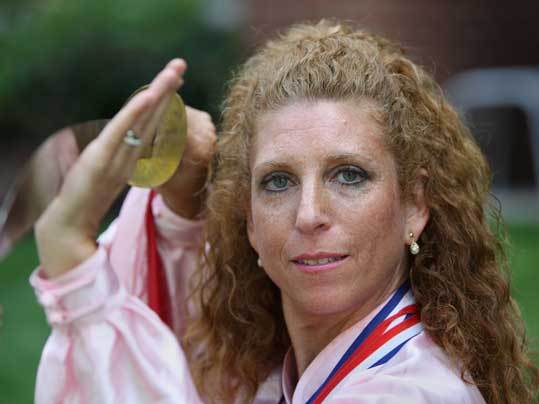
She trained for two months, squeezing in moments when she could - when she was brushing her teeth or at work when no one was looking. "Every day was a day of training," she said.

She returned to Massachusetts with five medals from national competition, taking gold in three events and silver in the others. "It's a very surreal experience. Sometimes I feel like, 'Wait a minute, I don't know how I got this.' "

When she thinks about it, though, she says she pictured it back when she was trying to be the tree.

She said she could see herself teaching, competing, becoming a different person.

"This is a whole new life," she said. "It's life-changing."

In a way, it's tree-like.

"Twenty years of training," she said. "Then you really identify with that."